
TMG™ SDK.
Embeds a High-Performance Thermal Solver in Any Simulation Environment
TMG™ SDK brings Maya HTT’s trusted thermal solver into your environment, allowing you to integrate thermal analysis alongside structural, electrical, fluid, and system-level simulations — all within a single platform.
Built for embedded thermal simulation
TMG™ SDK is designed for engineering software developers and enterprise teams who need high-performance thermal physics inside their own platforms.
Native backend integration
Embed TMG™ as a core thermal engine inside commercial engineering software, internal simulation tools, automated design workflows, or digital engineering platforms.
Proven thermal physics
Access finite volume and finite element formulations validated across aerospace, transportation, machinery, and energy industries.
High-performance thermal solver
Accelerate thermal simulations up to 400× faster than traditional CPU-based tools. Designed for large models and complex radiation analyses.
API-driven architecture
Call the solver directly from your application. Automate analysis setup, execution, and results retrieval without context switching.
Scalable deployment
Flexible licensing and deployment options that fit embedded engineering environments.
AI-enabled productivity
Enable AI agent integration to automate thermal simulations, design of experiments, and sensitivity analyses for faster engineering workflows.
Thermal simulation, embedded where you need it
High-performance thermal analysis no longer needs to run in a separate desktop tool.
TMG™ SDK eliminates workflow friction by embedding trusted physics directly into your engineering environment. Reduce validation time, automate design loops, and keep everything inside your platform.
Maya HTT is trusted by
21 out of 25
World’s largest aerospace & defense companies
9 out of 10
Top global electronics companies (including 4/5 FAANG)
1000s
Industry-leading customers across transport, machinery, energy, and more
High-performance thermal engine
TMG™ SDK delivers advanced thermal modeling capabilities including:
- Conduction, convection, and radiation
- Orbital radiation environment modeling
- Steady-state and transient analysis
- Support for nonlinear and anisotropic materials
- Multi-layer insulation modeling
All radiation computations can be executed with GPU acceleration to significantly reduce validation cycles.
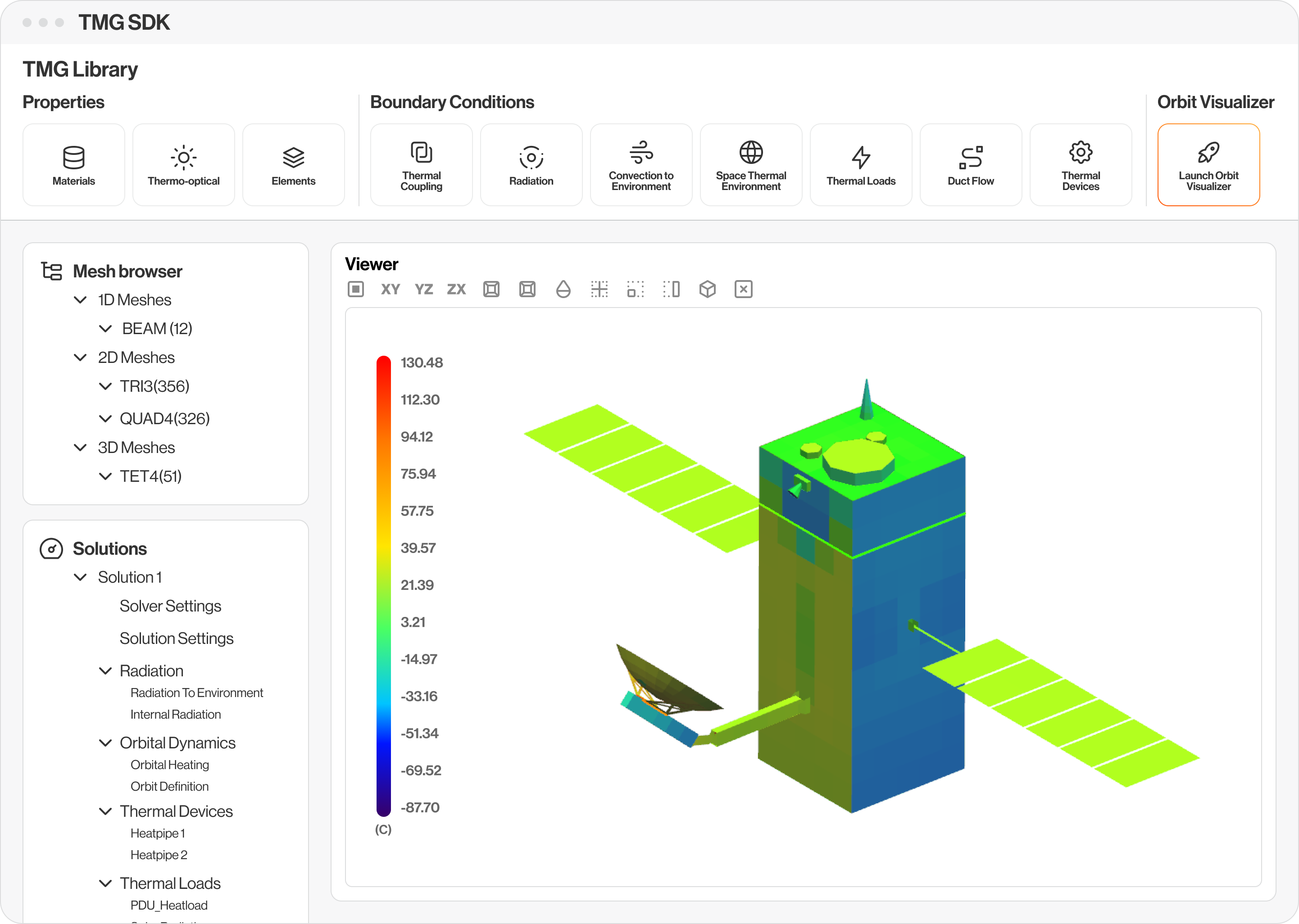
Up to 400x faster system validation
In benchmark testing, a complex radiation model runtime was reduced from:
127,233
seconds on CPU
311
seconds on GPU
Accelerate large design studies, parametric sweeps, and optimization loops without sacrificing physical fidelity for radiation-dominant models.
Designed for connectivity
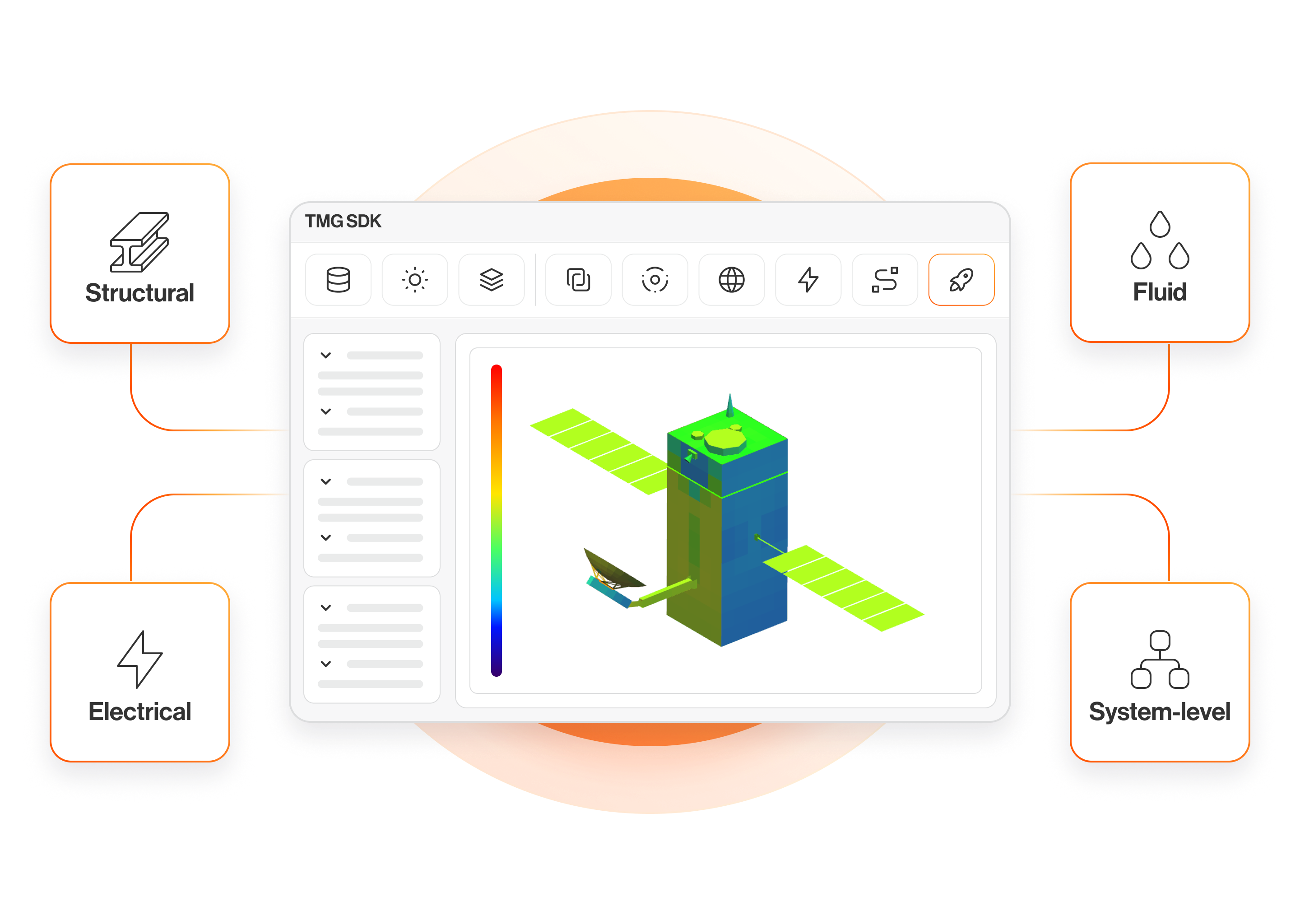
TMG™ SDK enables deep connectivity across simulation domains.
Integrate thermal analysis alongside structural, electrical, fluid, or system-level simulations within a unified digital engineering environment.
Ideal For
- Engineering software OEMs
- Internal enterprise simulation platforms
- Startups building next-generation engineering tools
- Large enterprises modernizing digital engineering workflows
Frequently asked questions
Does TMG™ SDK support both finite volume and finite element methods?
Yes, the TMG solver supports both finite volume and finite elements discretization schemes.
How does TMG™ SDK integrate into existing software platforms?
The TMG API has been written in a pure C interface so it is easy to embed in any modern language. To date, it has been successfully embedded into Python and JavaScript.
What hardware is required for GPU acceleration?
The GPU-acceleration capability for radiation analyses requires NVIDIA GPU cards with the Pascal microarchitecture or later with compute capability between 5.0 and 9.0a. TMG supports the NVIDIA CUDA 12.4 and later versions of the framework. Note that with CUDA 11.4, support for the older Kepler microarchitecture is deprecated.